
On the passing of my dad

Updated: Jul 29

How to encapsulate a life? How to encapsulate a man who at the age of 26 met and fell in love with my mother, whose first husband left her on Mother’s Day, declaring he had found another woman, leaving her scrambling to work in a carrot processing plant to feed and shelter my older brother Ernie and me? A man who signed up for 53 years of parenting two young boys, and having another, with all that comes with it?
Richard Anthony McCormack was born Feb. 6, 1946, the third of seven children, plus two nephews, and died 80 years later on June 26, 2026, after a brief struggle with cancer. He was diagnosed June 2 and died June 26, 24 days later.
But this is only the epidermis of the encapsulation, the outermost layer of what describes the man. He was also a father, a husband, the “cool uncle,” as I was told at his memorial service. He became a Christian but retained his Native roots, an elder in the Salinan Nation of Monterey and San Luis Obispo counties, where his people lived for at least 10,000 years. And this, this genetic and social makeup, is but the dermis, the secondary layer of facts that summarize his life.
He was a quiet man in his latter years, never recovering fully from the fog that assaulted his brain during his hospitalization from Covid. And yet, in the last two years of his life, he tackled the books on history I mailed him with aplomb, reading A People’s History of the United States in its entirety.
My mom walked in on him one day to find him subdued, teary eyed.
“What’s wrong?”
“I’m just sad about what they did to my people.”
He was a thoughtful, gentle soul. His kindness is a gentle mist that washes over me still.
My dad’s death has affected me in profound ways I’ve yet to understand.
I don’t like noise, except when I’m the one making it, blasting Pearl Jam or Neil Young, yelling at the television or at God. I prefer my own company, maybe one or two people at most. I despise sitcoms, more than I ever have, with their innocuous problems that are resolved in 30 minutes. Scandinavian crime dramas have been calling me. The stark landscape and exploration of a killer’s dark mind by a troubled, alcoholic policeman overdue for retirement are what comfort me.
Most of the time, however, the television is off, or if it’s on, I put on my airpods and escape into the world of Steinbeck, Colson Whitehead, or Ruben Degollado and his saga of the Izquierdo family, working and assimilating along the Rio Grande.
Dad grew up in San Lucas, down the road a way from the San Antonio Mission. His sister, Elaine, carved her name in a pew there as a naughty youngster who grew up to be the “Cool Aunt” and rock & roll grandma. Her name is still there. His younger brother, Alex, served in Vietnam and returned home a changed man, despised and rejected by his country but still moving forward and making his mark as a beloved uncle. He became part of the family fabric to embraced my mom, Ernie and I, welcoming us with birthday cakes, Christmas gifts, and Thanksgiving dinners.
As a young man, Dad hunted with his uncles and his brothers out in the mountains near the former Fort Hunter LIggett. There is a photo of 15 deer on a relative’s porch, with the men gathered around. They would dress the kill and divide it among themselves to sustain themselves and their families throughout the winter. “Dead-eye Dick,” my dad’s nickname, had a skill for bringing down deer, doves, and other wildlife.
He went hunting with the family for doves with the men in the family once, separating himself from the others with his nephew, Scott. They ventured into the mountains, taking a spot near a tree.
“Uncle Richard, are we going to stalk the doves and follow them?”
Dad shook his head, then drew his rifle.
“Pluck.”
“Pluck.”
“Pluck.”
Three doves lay at the foot of the tree, as the rest of the flock scattered.”
“Now wasn’t that easier?” he smiled and said to his nephew, Scott.
A day before he died, my mom was puttering around him, when he whispered “weh rah.”
“Richard, I don’t understand. What do you need?”
“Weh rah.”
“You want a wet rag?”
“Yeah.”
She raced to the kitchen, wetting a dish cloth and wiping it on his brow, face and neck. When she finished, he whispered. “More, more.”
After completing it a second time, he whispered “Wet rock.”
“You want a wet rock?”
“Yeah. Wet rock.”
Moments later, the morphine took effect, and he fell asleep.
She had prayed that his mind would remain clear until he died, and now, it looked like it hadn’t.
A day after he died, his nephew, Frank called to offer his condolences.
“Frank, I prayed he wouldn’t lose it, but near the end I think he did. He was asking for a wet rock.”
“Oh, he didn’t lose his marbles at all,” Frank said. “When we were hunting up in the mountains, we would be running out of water in our canteens. Uncle Richard taught us to grab a rock from the creek, wet it with a little water from our canteen, and put it in our mouths. It kept us cooler than gulping all the water down.”
“So he didn’t lose it at the end then?”
“Not a bit,” Frank said. “He knew exactly what he wanted.”
These days, m
y brain spits out memories like an errant restarted printer, like the time I backed up my car after clocking out at my dishwashing job and driving over the edge of the loading dock next door. My wheels spun helplessly over the edge like an upside down bug, and the rest of my car popped and groaned in protest. I called my dad, who bailed me out with a couple of 2X4s, chuckling all the way at his inept son.
My dad backed his 69 Camaro SS out of the driveway at his mom’s place on Santa Monica Court, the glimmering silver paint shining in the Salinas Valley afternoon sun. Instead of turning left toward home, he turned right.
“Where are you going?”
He gunned the 350, squealed the tires, popped the clutch, and proceeded to do five or six donuts in the court, all the while with my mom yelling at him to stop.
“More! More!” I screamed in his ear as I clung to his headrest like a monkey, as he chuckled.
Somewhere in my mom’s mountain of photos is a close-up of me leaning against Dad’s Camaro on the day he sold it. With my fist in my cheek, I looked absolutely dejected. He sold the car to buy something more practical and settle down. And he did. But he still listened to Credence and The Doors, and taught me a few bad words. So many, in fact, that the school called home when I was a kindergartener to report I was cussing too much and to please talk to me. My grandmother, a devout Christian and pillar of her church, had a Holy Ghost meltdown over that one, but it all worked out. He eventually became her favorite son-in-law, which is hilarious because dad’s competition was a minister.
I guess I printed umpteen million copies of the dad.pdf doc but didn’t have enough paper. Here is something else that came out. He never raised a hand against my mother, certainly, nor raised his voice. One time, though, when my mother pitched a fit over something and fled the house in her car, my dad didn’t go after her. He simply looked in my direction and gritted his teeth, his jaw muscles flexing out the way they rarely did.
“That woman,” he said, and walked off.
Dad always did the dirty work, the unenviable jobs none of us wanted to do.
My mom donated a kidney to my brother when he was five, my mom was 35, and I was 13. I can’t forget the story that has been passed down from Mom and Dad to us. My dad was outside taking a cigarette break during a grueling, 12-hour procedure. Our pastor didn’t smoke but stepped outside for moral support. Dad fidgeted, craving a cigarette after hours inside but didn’t want to offend the minister.
“Richard, you can have a cigarette,” he said. “It’s ok.”
My dad, relieved, lit up a smoke.
“I would give anything to be in one of those beds right now instead of either one of them,” Dad said.
He carried the family’s burdens in silent grace.
One afternoon, as the fog rolled over the Santa Lucia mountains and into the valley, I puttered in the front yard.
Dad approached me, looking somber.
“Jay, Sunny got hit by a truck.
“Oh,” I said, not knowing what to say. I went inside and told my mom, who offered words of comfort. The family golden retriever that we found in the classifieds, lived with us for all of two years before his life ended violently. What I didn’t realize at the time was that Dad moved Sunny off the road, put him in his truck, and likely took him to the county animal shelter for disposal. He never mentioned a word to us. He came back and possibly joined us for dinner.
Another time when I was in the front yard, Dad approached me. “Jay, Ernie is in the hospital. He…” Dad didn’t finish the sentence, but bowed his head and walked away, taking his time to return to the house. I met my mother in the kitchen, who explained that my older brother, a student at Cal, tried to take his life. He recovered. We all did.
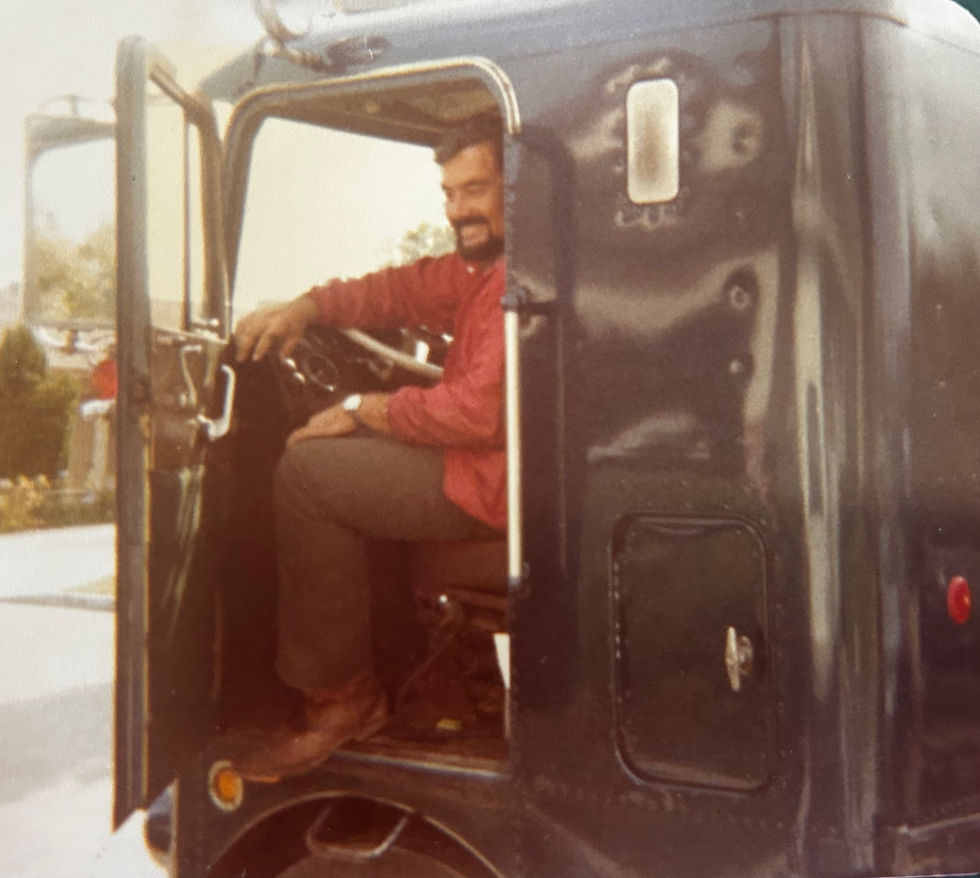
And so it went with Dad. He worked as a truck driver for nearly 35 years. He drove from Monterey County to the U.S.-Mexico border with loads of cool season vegetables, sacrificing his body to help put food on the table and a roof over our heads. He developed phlebitis, painful swelling in his legs, causing his feet to swell. Eventually, he had to have IVs at home to help him heal, but he kept driving. He left trucking and worked another 10 years as a coach operator, never complaining about the pain or hours.
And this is what drives me.

Comments